Many artists use their platforms to entertain. A few use them to say what many in the audience feel and few in power will say aloud. Over the past week, in Dublin, Paris and London, that choice filled arenas.
A song with a name
In May 2024, the American rapper Macklemore released “Hind’s Hall,” a protest song named after the building at Columbia University that students renamed in honour of Hind Rajab, the five-year-old Palestinian girl killed in Gaza in January 2024. He pledged all proceeds to UNRWA, the UN agency for Palestine refugees. In August 2026, Israel’s military acknowledged for the first time that its troops fired on the car in which Hind was trapped, and opened a criminal investigation.
The cost of speaking
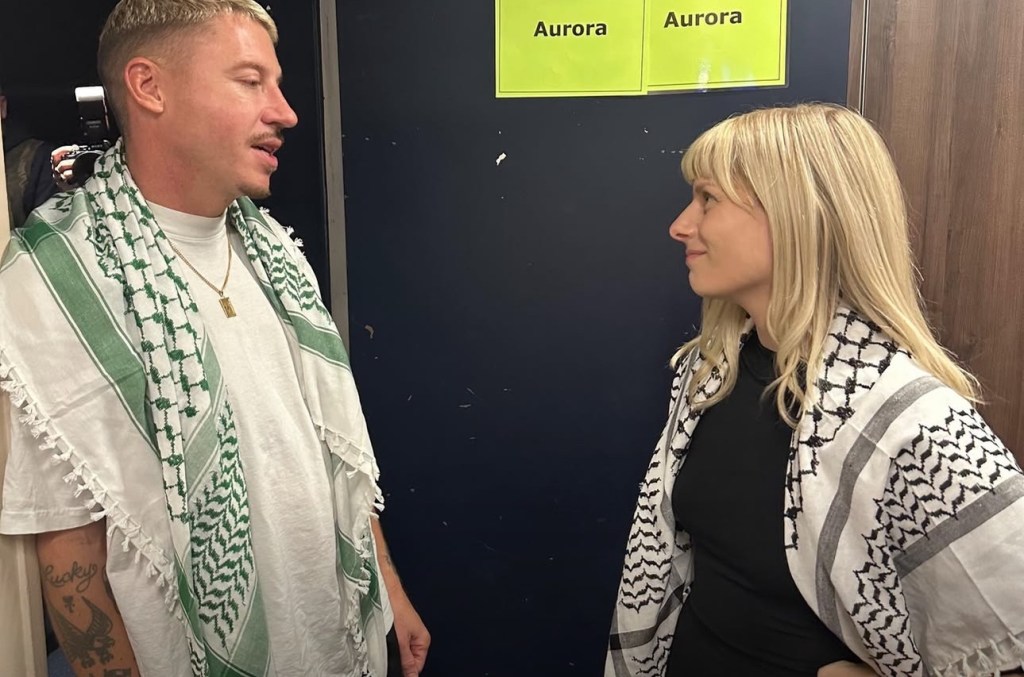
In September 2026, Macklemore was removed from Ed Sheeran’s U.S. stadium tour after leading pro-Palestinian chants and performing the song at MetLife Stadium. He answered by pledging $1 million to organisations supporting Palestinians and launching the Free Palestine Tour. It opened in Dublin on 26 October with guests including Hozier and Kneecap, continued at a sold-out Paris concert on 29 October, and ended its first European run at Wembley on 30 October. Proceeds go to organisations including Anera, Medical Aid for Palestinians, HEAL Palestine and the Middle East Children’s Alliance, and U.S. dates are expected to follow.
One shared conviction
The Norwegian singer AURORA joined the Paris concert, where she and Macklemore called for solidarity with Palestinians. Their music could hardly be more different, yet the principle is the same: an artist is not obliged to stay silent while civilians suffer. Art has always been able to carry truths into rooms where official language cannot reach, and to remind audiences that every statistic is a person.
When artists accept professional costs to stand for the dignity of the oppressed, they show that the arts and human rights share one root: the belief that every life deserves to be seen. That, in the end, is what art is for.



Leave a Reply